Every call. Every berth.Every anchorage.
A record of which vessel called where and when, at port, berth and anchorage level.
Both views come from open data. Our credits page names the sources.
What it covers
Checked against official records in three countries.
Why it exists
Most port data counts arrivals and departures. The time a ship spends waiting at anchor often goes unseen.
Port & Traffic Analytics links each anchorage stay, berth visit and port call into one record. You get waiting times, occupancy and density maps, checked against your own records.
What you get
- Port callsEvery call, from arrival to departure.
- Berth visitsWhich berth, from when to when.
- Anchorage staysEach wait at anchor, linked to the call it led to.
- Waiting timesHow long ships wait, anchorage by anchorage.
- OccupancyHow full each anchorage and berth is over time.
- Density mapsTraffic density, from one terminal to a whole sea.
- Checked recordsTested against official port records in three countries.
Three questions it answers
Who called here, and when?
Every call, berth stay and anchorage wait, linked together.
How long do ships wait?
Waiting times and occupancy, anchorage by anchorage.
How is this water really used?
Traffic density maps from one terminal to a whole sea.
Today
Port records sit in separate systems, and nobody sees the waiting at anchor.
Problems it solves
Today
With Port & Traffic Analytics
Port records sit in separate systems.
One record links anchorage, berth and call.
Nobody sees the waiting at anchor.
Waiting times show for every anchorage.
Anchorages and lanes are planned on guesswork.
Plans start from how ships really use the water.
Analysts build port data by hand for each study.
The record is ready, by port or by area.
Numbers from different sources disagree.
The record is checked against your own records.
How it works
- Choose your port or area. A terminal, a port or an area around it.
- We build the record. Each anchorage stay, berth visit and port call is linked to the visit it belongs to.
- We check it against your records. We compare calls and times with your own schedules and logs.
- You get tables, maps and reports. Waiting times, occupancy and density, by anchorage and by berth.
What you see
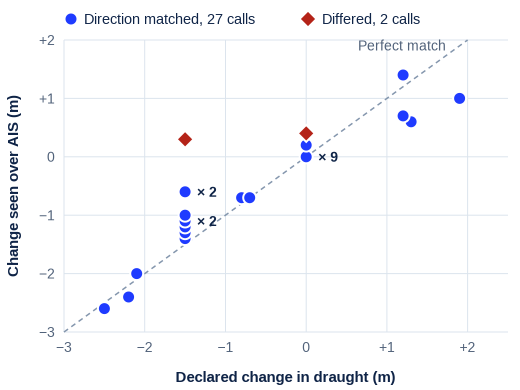
Port calls checked against the papers, and a density map of real traffic.
Real calls at a Finnish port. Each point is one call: the change in draught seen over AIS against the change declared in the papers.
One month of real ship tracks around Bergen. The brightest lanes are where ships spent most time.

Both views come from open data. Our credits page names the sources.
Port call, berth visit, anchorage stay
Three records, one visit
A port call is the whole visit to a port. A berth visit is the time alongside a quay, from first line ashore to last line released. An anchorage stay is the time at anchor, usually waiting for a berth.
One visit often holds several stops. A ship may wait at anchor, move to a berth, shift to a second berth, and wait at anchor again before it sails.
| Record | Starts | Ends | Where |
|---|---|---|---|
| Port call | The ship arrives at the port, for example at the pilot boarding place | The ship leaves the port | Within the port's limits, including its anchorages |
| Berth visit | First line ashore | Last line released | At a named berth of a terminal |
| Anchorage stay | The ship anchors | The ship heaves up its anchor | In a designated anchorage area |
A port is known by its UN/LOCODE, a five-character code such as TRGEM for Gemlik. A port holds terminals, and a terminal holds berths.
Where the limits come from
A port's limits and anchorages are set by law, not by a map maker. In Türkiye, the Ports Regulation lists each port's limits, anchorage areas and pilot boarding points.
These limits decide what counts as part of the call. A ship drifting just outside the port limits while it waits is not in the port. A ship at anchor inside them is.
Why the difference matters
- Waiting time. The time at anchor before the berth is the port's waiting time. Ports and ships can cut it by planning arrivals to a free berth.
- Money. Charter parties tie laytime to the ship's arrival at the port or the anchorage, and demurrage runs from there. A record that mixes up anchorage and berth gives the wrong answer to both.
- Statistics. A ship that anchors twice and berths at two terminals made one port call, two berth visits and two anchorage stays. Counting each stop as a call inflates traffic. Counting only berths hides the waiting.
- Reporting. The FAL Convention sets the documents a ship hands over on arrival and departure. Clear records keep those reports consistent with what happened.
Records do not always agree
The same visit can appear in the port's own log, in the agent's statement of facts and in records built from AIS positions. Each answers a slightly different question.
- The port's log records lines ashore and released.
- A statement of facts records the moments that matter for laytime.
- Position-based records see where the ship was, but not when its lines went ashore.
Comparing records only works when they use the same definitions for the same events.
Questions to ask of any port call data
- Which events does it record: port calls, berth visits, anchorage stays, or only some?
- What starts and ends each record, and where do the port limits come from?
- Are the visits linked, so an anchorage stay belongs to the port call that followed it?
- How does it handle short stops, shifts between berths, and the port's own service craft?
- Has it been checked against the port's own records, and how close did it come?
Data that answers these can be compared, port by port and month by month. Data that cannot gives numbers that look exact and are not.
Sources: Port Information Manual (port call data standard); IMO Just In Time Arrival guide; FAL Convention; Türkiye Ports Regulation.
Proven on a real port
A pilot at Gemlik in July 2024, checked against the port's own berth schedule and movement log.
97%
of the commercial calls we could observe were found: 268 of 276.
2.7 min
median difference between our arrival time and the port's record.
235
different vessels followed through the month.
3
linked events for one visit: the anchorage wait, the port stay and the terminal berth.
- One physical visit is stored as linked lines, so an anchorage wait and the berth stay that follows it read as one story.
- For each commercial call we also record the port the ship came from and the port it went to next. This shows where a port's traffic really comes from.
- Density maps measure the time ships spend in each cell of about 50 metres, not the number of messages received. Underway and stationary time are kept apart.
- The limits: one month, one port, one receiver. Where a ship sent no AIS at all, no tool can see it.
How the record is checked
The record is tested against official port records, and in the trial against your own. We show where it agrees and where it does not.
What we keep apart
So a reader never mistakes one for the other.
- A port call, a berth visit and an anchorage stay.
What it does not do
Where the product stops and your own judgement starts.
- Replace a port's billing records.
- Show ships that send no AIS.
Value by industry
Ports and terminals
Measure calls, berths and waits.
Calls, berths and waits are measured in separate systems, or not at all.
A full record of use, from anchorage to berth.
Government and coastal authorities
See how your waters are used.
Anchorages and lanes are planned without a clear view of use.
How ships really use the water, by area and over time.
Energy and bunkering
Plan around port traffic.
Supply plans miss how long ships wait at the ports you serve.
Waiting times and berth use at those ports.
Technology partners
Bring in traffic data.
Their platforms lack port calls and waits.
Port calls, waiting times and density through the API.
Who uses it
- Port authorities and operators
Use of anchorages and berths, and the waits.
For example: A port authority sees which anchorages fill first on busy days and how long ships wait there.
- Planners
A base for new anchorages, lanes and berths.
For example: A planner checks how ships really use an approach before moving an anchorage.
- Analysts and consultants
A ready record for studies.
For example: A consultant starts a study from a ready record for one port, and not from weeks of building data.
- Commercial teams
Waiting times at the ports they serve.
For example: A commercial team sees waiting times at a port before it fixes a ship.
Questions we hear first
- We already have port call data.
- Most of it starts at the berth. This links the wait at anchor to the call.
- Our own records are the truth.
- Good. We check our record against yours in the trial.
- Does it replace our billing system?
- No. It shows how the water is used, not what each ship is charged.
Frequently asked questions
Have a different question? Talk to us.
What is a port call here?
One visit by a vessel, linked to its berth stays and anchorage waits.
Which areas can you cover?
Any port or area you choose. We check the record against yours.
In which formats do we get it?
As tables, maps and reports. Tell us the format you need.
How often is it updated?
Talk to us about the update cycle that fits your area.
Goes with
- VTS Decision SupportWatch the approaches.
- Barbaros APIBring traffic data into your own platform.
Try it free on your own port
We offer free trials. Talk to us and we will fit one to your work. Pricing after that depends on how you use it.
A trial
One port for one month, checked against your own records.